I am currently studying for the AI-102 (Azure AI Engineer) exam using the deepdives-eu AI-102 Labs. They offer several modules, and they have been truly fantastic exercises.
Right now, I am working on the language detection lab. It is fairly simple to set up: it takes a text string and identifies its language.
For testing, I used the Swedish phrase, "Ingen ko på isen." It literally translates to "no cow on the ice," which is a Swedish idiom meaning everything is alright and there is nothing to worry about.
However, if you are meticulous about linguistics, Azure thinks there is a cow on the ice.
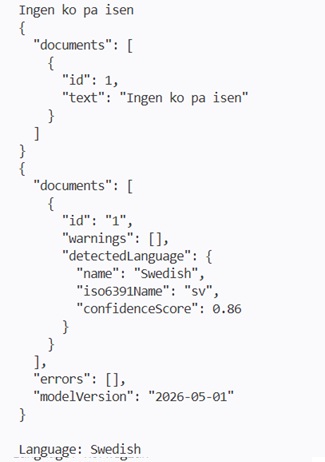
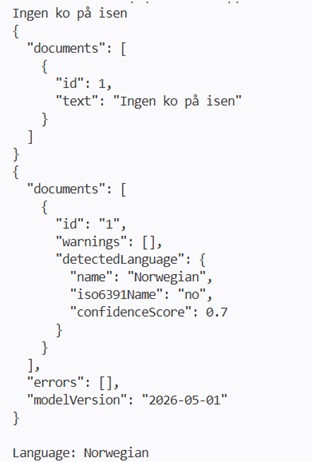
When I enter the correct phrase with the diacritic (på), Azure detects it as Norwegian. Oddly, if I remove the ring over the "a" and type "Ingen ko pa isen," the system correctly identifies it as Swedish.
From my research, the ring (å) should absolutely be there in Swedish. The actual difference between the Swedish and Norwegian versions of this idiom isn't the diacritic. The Norwegian equivalent is "Det er ingen ko på isen". Apparently, Norwegians prefer full sentences!
Regardless, "Ingen ko på isen" is definitively Swedish, and the ring belongs there.
I wonder how critical these issues are for organizations using generative AI, and whether they can be resolved without training custom models. While minor errors like this might not cause much concern, what happens if the wrong word is used in a critical legal document? Furthermore, how do organizations handle AI limitations in precise fields like mathematics? I hope to find answers to these questions soon.
This is "Ingen ko på isen". Notice, it comes back as Norway
This is "Ingen ko pa isen", which is missing the diacritic. Notice, it comes back correctly as Swedish, but is grammatically wrong. The ring should be there.